REVIEW · KAUAI
Kauai’s Ultimate Group Surf Lesson
Book on Viator →Operated by Hawaiian Style Surfing · Bookable on Viator
Kauai surfing in 90 minutes. This small-group lesson on the island focuses on real ocean safety first, then coaching that helps you get your first rides. What makes it especially appealing is the setup: you’re taught fundamentals on land, then you hit the water with an instructor watching closely.
I love how beginner-friendly it feels without being watered down. There’s no experience required, the class stays small (no more than five people per instructor), and the gear is handled for you. I also like that you get more than just standing near a surfboard and hoping for luck. The lesson aims at getting you up and riding your first wave, even if that first attempt is wobbly.
One drawback to consider: the lesson is weather- and wave-dependent. If conditions aren’t right, you’ll need to be flexible, and you should be ready for some rocky moments near shore depending on where the session lands.
In This Review
- Key things to know before you go
- Why this 1.5-hour Kauai surf lesson works for first-timers
- Meeting in Koloa and getting set up fast
- Land lesson first: surf basics and ocean safety you’ll actually use
- The water session: standing up and getting real wave time
- Small-group coaching: why the instructor names matter
- What’s included (and what you’ll want to bring)
- Price and value: is $121.86 worth it?
- Timing, fitness level, and the ocean reality check
- Surf-ready tips for your Kauai day
- Should you book this Kauai group surf lesson?
- FAQ
- How much does Kauai’s Ultimate Group Surf Lesson cost?
- How long is the lesson?
- What’s included in the surf lesson?
- What should I bring since towels aren’t included?
- Where do I meet for the lesson?
- How big are the groups?
- Do I need prior surfing experience?
- What language is the lesson offered in?
- What is the cancellation policy?
Key things to know before you go
- No experience needed, with coaching aimed at your first wave, not theory
- Small-group instruction, with instructors keeping the class tight (max five per instructor)
- All equipment included: surfboard, rash guard, and water shoes
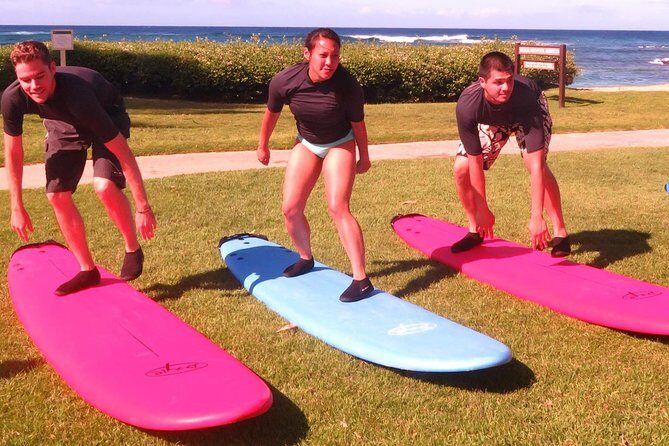
- Land lesson before the ocean, built around surf fundamentals and ocean safety
- Instructors named in the field, including Adam, Kai, Tom, Nolan, Hudson, and Austin
- Time-efficient format at about 1.5 hours, with the water time doing the heavy lifting
Why this 1.5-hour Kauai surf lesson works for first-timers
This isn’t a half-day “surf school” that spends most of your time changing into gear and waiting around. The class is about 1 hour 30 minutes, so you’re moving through the lesson while excitement is still high. That matters because learning to surf is partly muscle memory, and you build it faster when the session isn’t dragged out.
The course design is simple: you start with basics and safety on land, then you go straight into the ocean. You’re not left to guess what to do once you’re in waist-to-chest deep water. You’ll get direct coaching for the key moments: paddling, positioning, popping up, and handling wipeouts.
It also helps that the group stays small. With no more than five people per instructor, you’re less likely to get left behind while one confident surfer gets all the attention. In practice, this means you can ask questions in the moment and you’re more likely to get corrections based on what you’re doing wrong, not what you did wrong in your imagination.
Other surf lessons we've reviewed in Kauai



Meeting in Koloa and getting set up fast
Your meeting point is at 2440 Hoonani Rd, Koloa, HI 96756. The activity ends back at the meeting point, so you’re not dealing with complicated drop-offs and pickups. If you’re staying in the Poipu area, this is one of those “get there, park or Uber, check in, go surf” situations that fits neatly into a beach day.
This tour uses a mobile ticket, and you should receive confirmation within 48 hours of booking, depending on availability. You’ll also find it convenient that it’s near public transportation, which is useful if you’re not renting a car for the day.
Before you’re in the water, you’ll be set up with the essentials: board, rash guard, and water shoes are included. That’s a big deal on Kauai, where you want to show up ready to move and not start the day hunting for the right footwear.
Land lesson first: surf basics and ocean safety you’ll actually use
The lesson starts with a short land session focused on surf fundamentals and ocean safety. Even if you’ve watched surf videos for years, this step can save you from common beginner mistakes. It’s where you learn how instructors want you to behave around the water, how to understand the lineup, and what to watch for before you get your board in motion.
This part is valuable because ocean safety isn’t just a lecture. When instructors tell you what to do with your body and where to position yourself, it changes everything once you’re out past the break. You’ll be less likely to panic when the ocean does its thing, because you already have a mental checklist.
In the water, that mindset pays off fast. Several people highlight how patient and encouraging their instructors were, and that usually comes from coaching that starts with clear expectations. You can feel the difference between random instructions and a plan that builds.
The water session: standing up and getting real wave time
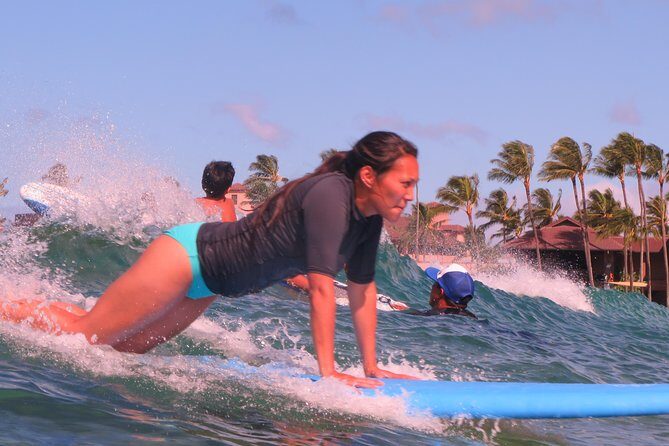
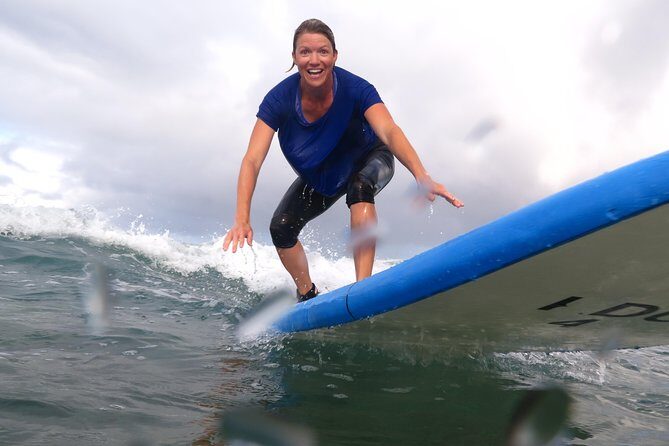
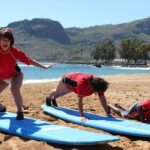
After the land basics, the rest of the lesson is in the water. The goal is not just to paddle around and call it surfing. The lesson is designed to help you get up and ride your first wave with help from your instructor.
How it usually works in a strong beginner class:
- You practice positions and movement on the board
- Then you try again with the instructor’s feedback
- As your timing improves, you get more chances to stand
The lesson structure also explains why so many first-timers leave feeling proud rather than exhausted. You’re repeatedly guided through the parts that matter most for success: paddling with purpose, timing your pop-up, and staying balanced when the board shifts.
Some sessions are mentioned at Poipu Beach, and that makes sense given how often Kauai beginners start in the south-shore area. If your class is at that kind of shoreline, you’ll likely get a setup that feels manageable for early learning.
One thing to keep in mind: waves can vary. A few experiences note that conditions were more challenging than expected, but instructors still helped people catch rides. That’s a good sign. It means you’re not learning only on perfect days.
Small-group coaching: why the instructor names matter
When you see the same names come up again and again, it’s usually because the teaching style clicks with beginners. Here, people mention instructors like Adam, Kai, Tom, Nolan, Hudson, and Austin. The common thread is patient, positive coaching that focuses on keeping you safe and confident while you learn.
One of the best beginner-learning advantages is encouragement that doesn’t sugarcoat the moment you wipe out. Several instructors are praised for being personable, calm, and able to push you just enough to try again after a fall. That psychological piece matters. Surfing teaches you that failure is part of the process, and a supportive instructor helps you stop seeing wipeouts as humiliation.
That said, there’s one fair caution: not every instructor style will feel equally detailed to every person. At least one experience notes a case where advice felt less specific. If you’re the type who needs very explicit step-by-step direction, arrive with a mindset to ask for that. A simple question like what to do differently next attempt can help.
A few more Kauai tours and experiences worth a look





What’s included (and what you’ll want to bring)
This lesson includes the gear you’d hate to forget:
- Surf board
- Rash guard
- Water shoes
That reduces friction a lot. On Kauai, you don’t want to burn time figuring out rentals or worrying whether the board fits you. Rash guards also help with comfort and board grip during learning.
What’s not included:
- Towels
- Trip protection (and there’s a strict cancellation/refund structure around it)
So I recommend you plan for the basics: bring a towel, and pack your own sunscreen and a way to keep valuables safe while you’re out. You’ll also want to wear comfortable clothes for before/after, since you’ll likely rinse and dry after the session.
Price and value: is $121.86 worth it?
At $121.86 per person for about 1.5 hours, this sits in the higher end of “activity” pricing, but the value is tied to what’s included and how targeted the coaching is. You’re paying for:
- A real instructor-led lesson
- Small-group attention
- Ocean safety basics
- The equipment (board, rash guard, water shoes)
If you’ve ever looked at surf rentals plus a lesson, the combined cost often climbs fast. Here, the equipment is included, which lowers the chance you’ll spend extra money just to participate.
For me, the real value is the learning outcome. When the class is small and the instructor is guiding your first rides, you’re not just buying a scenic beach time. You’re buying skills that you can use afterward, which is why many people describe leaving more confident than when they arrived.
Also, group surfing can be a sweet spot for families. People mention ages ranging from young kids to adults, and the format can work when the instructor is patient. If you’re traveling with multiple people, a small-group lesson is often more manageable than doing separate lessons that require more time and coordination.
Timing, fitness level, and the ocean reality check
This experience is listed for travelers with a moderate physical fitness level. Surfing uses more effort than most first-timers expect. Even when you catch just a few waves, you’re paddling, popping up, and resetting your position over and over. Expect it to feel like a workout, not a gentle stroll.
You should also know the session is dependent on good weather. If conditions aren’t workable, you’ll be offered a different date or a full refund. That’s fair, and honestly it’s the right call for ocean-based activities.
Waves can also change during the day, which is why flexibility is part of the deal. One account describes a trip postponement due to wave conditions, with the team rescheduling rather than just canceling. If you’re the type who hates uncertainty, it helps to build your schedule with a bit of breathing room.
Finally, keep an eye on shore hazards. One experience includes a caution about big rocks near the lesson area. That doesn’t mean you shouldn’t go, but it does mean you should follow your instructor’s guidance about where to move and where not to stand.
Surf-ready tips for your Kauai day
Here are practical moves that help you get more out of the lesson without overthinking it.
Wear what won’t chafe. Since you get a rash guard, your main job is to avoid adding discomfort with ill-fitting clothing under it. For after, towel off and protect your skin from sun.
Be honest about your swimming comfort. The lesson is in the ocean, so feeling comfortable in the water helps you learn faster and stay calm. If swimming is a concern, don’t guess—ask questions before you commit.
Plan a simple pre- and post-lesson snack plan. You’ll spend energy paddling. If you show up hungry, you’ll feel it. If you show up too full, you might feel heavy during paddling. A light meal and water is a good compromise.
If you’re making this a full beach outing, pair it with turtle spotting. One person notes a nearby place where you can sometimes see turtles, with a suggested best time around 6pm or early morning. That’s a nice follow-on because it keeps your day relaxed after you’ve earned your surf story.
Should you book this Kauai group surf lesson?
You should book if you want a beginner surf experience with real coaching and you value small-group attention. It’s a strong fit for couples, families, and solo travelers who want a fun challenge without needing previous surfing experience.
It’s also a good match if you’re trying to keep things efficient. You get a land lesson plus water time in about 90 minutes, and the class includes the main gear you’d otherwise have to rent. That cuts down on hassle.
Skip or rethink if you’re very sensitive to changing ocean conditions. The session depends on weather and waves, and you should be comfortable with potential rescheduling. Also, if you need very highly specific step-by-step instruction and you know you get frustrated with general coaching, be ready to ask for clearer directions during the lesson.
If you want an authentic Kauai memory that feels earned, this is one of the better bets: you’re not just looking at the ocean, you’re learning how to move on it—under close, patient supervision—until your first wave happens.
FAQ
How much does Kauai’s Ultimate Group Surf Lesson cost?
The price is $121.86 per person.
How long is the lesson?
The lesson lasts about 1 hour 30 minutes.
What’s included in the surf lesson?
You’ll receive a surf board, a rash guard, and water shoes.
What should I bring since towels aren’t included?
Towels are not included, so plan to bring your own. You’ll also want to come prepared for time in the ocean and sun.
Where do I meet for the lesson?
You start at 2440 Hoonani Rd, Koloa, HI 96756, USA, and the activity ends back at the meeting point.
How big are the groups?
There is a maximum of 16 travelers, and instructors keep the class to no more than five people per instructor.
Do I need prior surfing experience?
No experience is necessary. It’s set up for surfing beginners.
What language is the lesson offered in?
The lesson is offered in English.
What is the cancellation policy?
You can cancel up to 24 hours in advance for a full refund. If you cancel less than 24 hours before the start time, there is no refund. If the experience is canceled due to poor weather, you’ll be offered a different date or a full refund.